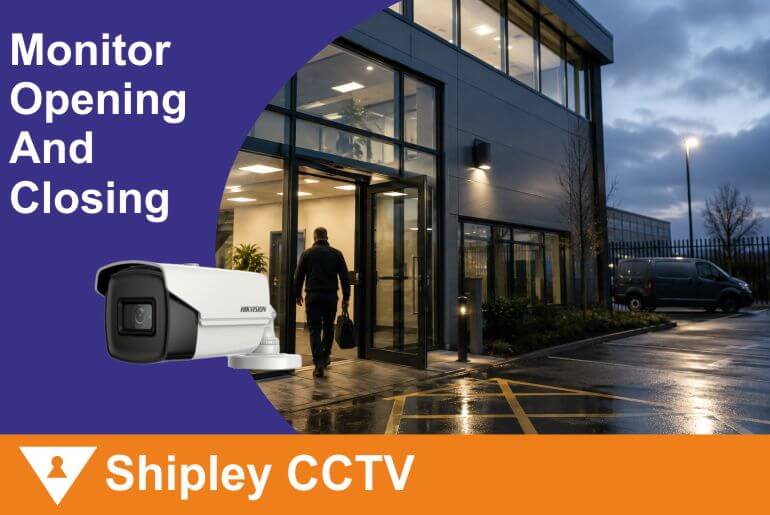
CCTV to Monitor Opening and Closing Procedures –
Opening and closing a commercial premises often becomes such a familiar routine that little thought is given to it. A member of staff unlocks the building, disables the security system and prepares the premises for the working day. At closing time, somebody checks the building, secures doors and leaves.
Most days, nothing goes wrong.
But when something does, a surprisingly simple question can become difficult to answer: what actually happened when the premises were opened or closed?
For businesses across Shipley, professionally installed CCTV can provide an independent record of these important periods without requiring managers to supervise employees carrying out routine duties.
Closing procedures provide a good example. Depending on the business, the final employee may be responsible for checking external doors, ensuring customer areas are empty, securing stock and confirming that other members of staff have left.
If a door is discovered unsecured the following morning, CCTV may help establish whether it was properly closed and whether anybody approached the premises afterwards.
This can prevent assumptions being made about the employee who locked up.
Opening procedures can benefit in a similar way. Staff arriving early may be entering a building before surrounding businesses are open and when fewer people are nearby. External CCTV provides visibility of entrances, car parks and approaches during these quieter periods.
Retail businesses face particular challenges at opening and closing times. Employees may be preparing tills, receiving early deliveries or moving stock while customer entrances remain locked. CCTV can provide useful context if an unusual event occurs during this transition between closed and open trading.
Offices have different routines. Cleaners may leave shortly before the first employees arrive, while maintenance contractors could have attended overnight. Recorded footage helps create continuity between these periods and can establish who accessed relevant parts of the premises.
Industrial businesses may have shift changes rather than conventional opening hours. One team leaves as another arrives, creating periods of concentrated pedestrian and vehicle activity. CCTV covering appropriate entrances and external areas can provide valuable evidence if an incident is later reported.
The system can also help managers identify weaknesses in procedures.
For example, footage may show that a delivery entrance is routinely left open for several minutes while staff carry out another task. An external gate might be secured before all vehicles have left, resulting in employees repeatedly reopening it. Identifying these patterns allows procedures to be improved without waiting for a security problem.
CCTV should not be used to unnecessarily scrutinise individual employees. Its value lies in providing objective information about how important processes operate and offering evidence when something unexpected happens.
Professional camera positioning is therefore important. Entrances, exits, reception areas, loading access and appropriate external routes often provide considerably more useful footage than cameras installed without a defined purpose.
Integration with other security systems can add further context. Where appropriate, CCTV footage can complement intruder alarm and access control information, helping authorised managers establish a clearer timeline of events around the building.
Modern CCTV also makes footage considerably easier to retrieve than older systems. High-definition recordings and straightforward playback allow authorised users to investigate a particular period without manually searching through an entire day’s footage.
Businesses should nevertheless manage recordings responsibly. Clear policies should establish who can access CCTV, why footage may be reviewed and how recordings are handled.
Opening and closing procedures should also be reassessed whenever the business changes. Additional entrances, different staff working patterns or extended trading hours may mean the existing CCTV arrangement no longer reflects how the premises operate.
For businesses throughout Shipley, these short periods at either end of the working day deserve more attention than they often receive.
The premises may contain valuable equipment, stock and confidential information, yet responsibility can temporarily rest with just one or two people.
Professionally designed CCTV provides an additional layer of visibility.
When everything goes according to plan, the recordings may never need to be reviewed. But when somebody asks who was last to leave, whether a door was secured or what happened before the first employee arrived, having clear footage can turn uncertainty into a straightforward answer.